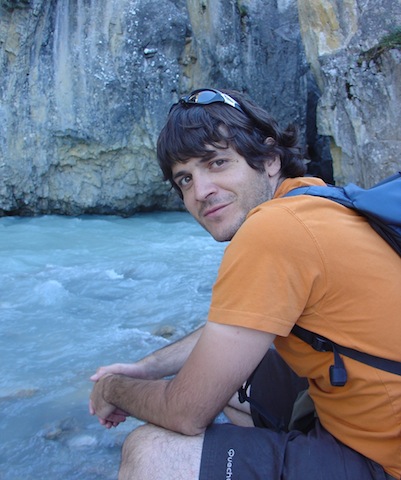
Dr. Marc Macias-Fauria
Academic Profile
My research is directed at understanding the interactions between physical and biological systems in wooded ecosystems over spatial scales ranging from study sites to continents and temporal scales ranging from decades to millennia. Ecological processes are coupled with physical mechanisms such as atmospheric dynamics and/or geomorphology, among others (i.e. ecology is largely controlled or constrained by the physical environment). My research interests also encompass the effects of land use in these ecosystems (e.g. grazing).
I gained my first degree in Biology at the University of Barcelona, a M.Sc. at the Department of Biological Sciences of the University of Calgary, and a Ph.D. at the Department of Geology (now Department of Geosciences and Geography) of the University of Helsinki, where I studied the coupling of forest wildfires, tree-growth, and insect outbreaks with climate. I have also worked in palaeoclimatology, using proxy data such as tree-rings, schlerochronologies, or ice core isotopic composition. At the present I am actively researching in these fields.
Over the past two years I have been a post-doctoral fellow at the University of Calgary, working on a project that seeks to understand the patterns of altitudinal treeline and their coupling to structural geology and slope geomorphologic processes in the Canadian Rocky Mountains, as well as in a dendrochronological study of the recent growth trends of the tundra woody shrub species Salix lanata and Alnus fruticosa in the Nenets Autonomous Region and the Yamal Peninsula (Western Siberia, Russia).
Current Research
My main project at Oxford investigates the occurrence of cryptic woody plant refugia in northern Eurasia since the Last Glacial Maximum (25-17,000 yr cal B. P.) to the present, based on plant macrofossil samples.
Coarse-scale models that predict climate change-induced habitat losses may have over-estimated extinction threats due to their inability to capture small-scale habitat heterogeneity, and are difficult to validate. Proposed validations use current data as calibration and past data as verification. The Quaternary fossil record is thus essential to understand the mechanisms that have allowed past species persistence, and to improve our forecasting ability regarding their future performance, although it has too been affected by coarse-scale issues. Evidence for woody taxa populations north of the classical pollen-based southern refugia during the last glacial maximum (LGM) has recently come from DNA and macrofossil studies. LGM refugia existed as habitat islands in a matrix of unsuitable landscapes, from which populations expanded in the Holocene. Such small populations – cryptic refugia – are indistinguishable in the pollen record and coarse scale bioclimatic envelope models don’t detect them. Persistence of many species in future climates may, as it has in the past, depend on the preservation of cryptic refugia, and defining their physical environment is of great importance. This study aims at defining the physical characteristics – topographical and geomorphic – of cryptic refugia for three Northern Eurasian tree taxa and integrate the resulting relevant physical parameters to high-resolution species envelope models to improve our understanding of the role of cryptic refugia on species persistence during past climate changes, and so to better forecast biotic response to future climate changes.
Downloads
'Reconstats' calculates the significance of dendroclimatic reconstruction statistics based on simple and multiple linear regressions.
Download 'Reconstats' software here.
Contact
marc.maciasfauria@zoo.ox.ac.uk
http://www.researcherid.com/rid/A-4591-2009
Publications
Published or accepted
2012
- Macias-Fauria M., Forbes B.C., Kumpula T., and Zetterberg P. (2012) Eurasian Arctic greening reveals teleconnections and the potential for novel ecosystems. Nature Climate Change (In press).
- Macias-Fauria M., and Willis, K.J. (2012) Landscape planning for the future: using fossil records to independently validate Bioclimate Envelope Models for economically valuable tree species in Europe. Global Ecology and Biogeography (In press)
- Macias-Fauria M. and Grinsted A., Helama S., and Holopainen J. (2012) Persistence matters: estimation of the statistical significance of paleoclimatic reconstruction statistics from autocorrelated time series. Dendrochronologia (Early view). DOI: 10.1016/j.dendro.2011.08.003
2011
- Myers-Smith I, Forbes B.C., Wilmking M., Hallinger M., Lantz T., Blok D., Tape K.D., Macias-Fauria M., Sass-Klaassen U., Lévesque E., Boudreau S., Ropars P., Hermanutz L., Trant A., Siegwart Collier L., Weijers S., Rozema J., Rayback S.A., Martin Schmidt N., Schaepman-Strub G., Wipf S., Rixen C., Ménard C., Venn S., Goetz S., Andreu-Hayles L., Elmendorf S., Epstein H.E., Welker J., Grogan P., and Hik D. (2012) Shrub expansion in tundra ecosystems: Dynamics, impacts and research priorities. Environmental Research Letters 6: 045509. DOI: 10.1088/1748-9326/6/4/045509
- Nairn-Birch N., Diez D., Eslami E., Macias Fauria M., Johnson E.A. and Schoenberg F.P. (2011) Simulation and Estimation of Probabilities of Phases of the Pacific Decadal Oscillation. Environmetrics 22: 79–85. DOI 10.1002/env.1030
2010
- Macias Fauria M.*, Michaletz S.T.*, and Johnson E.A. (2010) Predicting climate change effects on forest wildfires requires linking processes across scales. WIREs Climate Change 2(1): 99-112. DOI: 10.1002/wcc.92.
- Helama S., Macias Fauria M., Mielikäinen K., Timonen M., Eronen M. (2010) Sub-Milankovitch Solar Forcing of Past Climates: Mid and Late Holocene Perspectives. Geological Society of America Bulletin 122(11/12): 1981-1988. DOI: 10.1130/B30088.1.
- Helama S., Läänelaid A., Tietäväinen H., Macias Fauria M., Kukkonen I.T., Holopainen J., Nielsen J.K., Valovirta I. (2010) Late Holocene climatic variability reconstructed from incremental data from pines and pearl mussels – a multi-proxy comparison of air and subsurface temperatures. Boreas 39(4): 734–748. DOI 10.1111/j.1502-3885.2010.00165.x.
- Forbes B.C.*, Macias Fauria M.*, and Zetterberg P. (2010) Russian Arctic warming and ‘greening’ are closely tracked by tundra shrub willows. Global Change Biology 16: 1542–1554. DOI: 10.1111/j.1365-2486.2009.02047.x.
- Macias Fauria M., Grinsted A., Helama S., Moore J., Timonen M., Martma T., Isaksson E. and Eronen M. (2010) Unprecedented low twentieth century winter sea ice extent in the Western Nordic Seas since A.D. 1200. Climate Dynamics 34:781–795. DOI 10.1007/s00382-009-0610-z.
2009
- Helama S., Nielsen J.K., Macias Fauria M., and Valovirta I. (2009) A fistful of shells: Amplifying sclerochronological and palaeoclimate signals from molluscan death assemblages. Geological Magazine 146(6): 917-930. DOI:10.1017/S0016756809990033.
- Macias Fauria M., and Johnson E.A. (2009) Large-scale climatic patterns control area affected by mountain pine beetle in British Columbia, Canada. Journal of Geophysical Research 114: G01012. DOI:10.1029/2008JG000760.
2008
- Macias Fauria M., Helle, T., Niva, A., Posio, H., and Timonen, M. (2008) Removal of lichen mat by reindeer enhances tree-growth in a northern Scots pine forest. Canadian Journal of Forest Research 38(12): 2981-2993. DOI:10.1139/X08-135.
- Macias Fauria M., and Johnson E.A. (2008) Climate and wildfires in the North American boreal forest. Philosophical Transactions of the Royal Society B 363: 2317–2329. DOI:10.1098/rstb.2007.2202.
2007
- Andreu L., Gutiérrez E., Macias M., Ribas M., Bosch O., and Camarero J.J. (2007) Climate increases regional tree-growth variability in Iberian pine forests. Global Change Biology 13 (4): 804–815. DOI: 10.1111/j.1365-2486.2007.01322.x.
2006
- Macias Fauria M., and Johnson E. A. (2006) Large-scale climatic patterns control large lightning fire occurrence in Canada and Alaska forest regions. Journal of Geophysical Research 111: G04008. DOI: 10.1029/2006JG000181.
- Macias Fauria M., Andreu L. Bosch O., Camarero J.J., and Gutiérrez E. (2006) Increasing aridity is enhancing Silver fir (Abies alba Mill.) water stress in its south-western distribution limit. Climatic Change 79: 289-313. DOI: 10.1007/s10584-006-9071-0.
2004
- Macias M., Timonen M., Kirchhefer A.J., Lindholm M., Eronen M., and Gutiérrez E. (2004) Growth Variability of Scots Pine (Pinus sylvestris) along a West-East Gradient across Northern Fennoscandia: A Dendroclimatic Approach. Arctic, Antarctic, and Alpine Research 36(4): 565–574. DOI: 10.1657/1523-0430(2004)036[0565:GVOSPP]2.0.CO;2.
* Contributed equally to this work
Submitted
Helama S., Holopainen J., Macias-Fauria M., Timonen M., Mielikäinen K. A chronology of climatic downturns through the mid and late Holocene - tracing the distant effects of explosive eruptions from palaeoclimatic and historical evidence in Northern Europe. Submitted to Polar Research.
In preparation
Macias-Fauria M., and Johnson, E.A. Geologic and geomorphic controls of altitudinal treeline in the Canadian Rocky Mountains.
Conference presentations
-
Planet Under Pressure 2012, London, United Kingdom. Poster Presentation. Title of poster: Landscape Planning for the Future: Using Fossil Records to Independently Validate Potential Threats, Opportunities and Likely Future Range-Shifts for Socio-Economically Valuable Plant Species in Europe and Sub-Saharan Africa (Confirmed).
-
Landscape planning for the future: using fossil records to map potential threats, opportunities and likely future developments for biodiversity and ecosystem services. 2012, Oxford, United Kingdom. Oral Presentation. Title of the talk: Using the palaeo-record to forecast performance of plant species under future climate scenarios.
-
Mountain Research Initiative (MRI) Key Contact Workshop. 2011, Berkeley, California. Oral presentation. Title of the talk: The altitudinal treeline in the Canadian Rocky Mountains of Alberta.
-
AGU (American Geophysical Union) Fall Meeting 2011, San Francisco, California. 2 Poster Presentations. Title of poster 1: Climate insensitivity of treeline in the Canadian Rocky Mountains. Title of poster 2: Landscape planning for the future: using fossil records to independently validate potential threats, opportunities and likely future range-shifts for socio-economically valuable plant species in Europe and sub-Saharan Africa.
-
1st workshop of NordForsk-BioCold 2011, Palmse, Estonia. Oral presentation. Title of the talk: Creating conditions for persistence of biodiversity in the face of climate change.
-
5th workshop of NordForsk-LANDCLIM 2011, Riga, Latvia. Poster Presentation. Title of poster: Potential tree species range shifts under a warmer climate: what can we learn from the Medieval Warm Period period in Europe?
-
AGU (American Geophysical Union) Fall Meeting 2010, San Francisco, California. Poster Presentation. Title of the poster: Geologic and geomorphic controls of altitudinal treeline in the Canadian Rocky Mountains.
-
World Dendro 2010, Rovaniemi, Lapland, Finland. Oral presentation. Title of the talk: Application of Monte-Carlo methods to estimate the significance of paleoclimatic and dendroclimatic calibration-verification statistics from autocorrelated time-series.
-
AGU (American Geophysical Union) Fall Meeting 2009, San Francisco, California, USA. Poster Presentation. Title of the poster: Structural and Geomorphic Controls in Altitudinal Treeline: a Case Study in the Front Ranges of the Canadian Rocky Mountains.
-
CGU (Canadian Geophysical Union)/ AGU (American Geophysical Union) Joint Assembly 2009, Toronto, Ontario, Canada. Oral presentation in the symposium: ‘What Is Biogeoscience?’ Title of the talk: Wildfires, mountain pine beetle and large-scale climate in Northern North America.
-
Fields Workshop on Spread in Forests 2007, London, Ontario, Canada. Oral presentation. Title of the talk: Pacific Decadal Oscillation control of mountain pine beetle outbreaks in western Canada.
-
92nd ESA (Ecological Society of America) meeting 2007, San José, California, U.S.A. Oral presentation. Title of the talk: Climate-driven mountain pine beetle outbreaks in British Columbia, Canada.
-
90th ESA/INTECOL (Ecological Society of America / International Association for Ecology) meeting 2005, Montréal, Québec, Canada. Oral presentation in the symposium: ‘The Boreal forest and Global Change’.
-
Eurodendro 2005, Viterbo, Italy. Oral Presentation. Title of the talk: Increasing aridity is enhancing Silver fir (Abies alba Mill.) water stress in its south-western distribution limit.
-
Arctic Council Northern timberline Forests Workshop 2002, Rovaniemi, Lapland, Finland. Poster Presentation. Title of the poster: Study of the spatial-temporal variability of a 22 tree-ring chronology network in a W-E transect across northern Fennoscandia and of its relationships with temperature, precipitation and NAO indices.
-
Eurodendro 2001, Gozd Martuljek, Slovenia. Poster Presentation. Title of the poster: Tree-ring growth chronologies of Abies alba: assessment of the Atlantic-Mediterranean gradient along the Pyrenees.